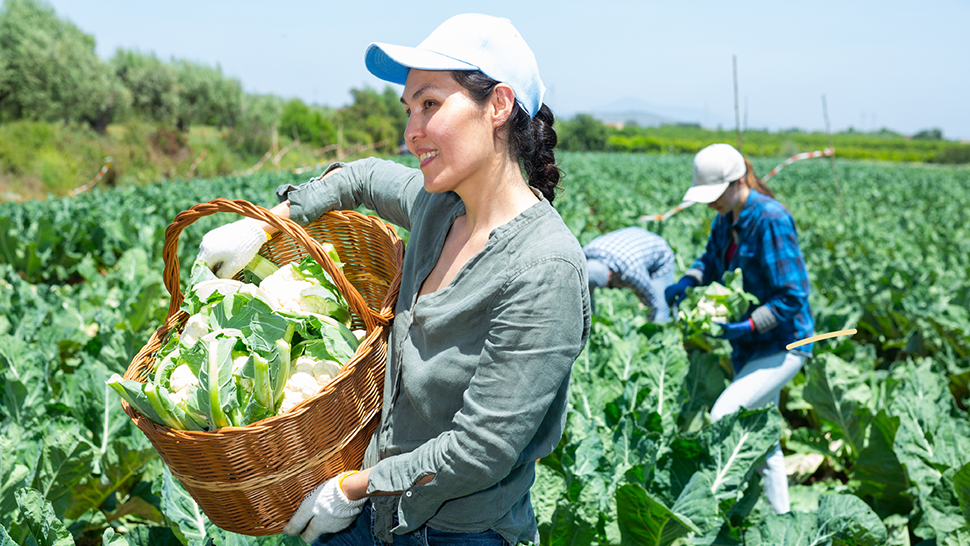
This National Farmworkers Awareness Week, we are thrilled to partner with Student Action with Farmworkers (SAF), the student-led nonprofit responsible for organizing this nationwide event for the past 28 years. SAF’s mission is to bring students and farmworkers together to learn from one another, share skills, and work collectively to improve labor conditions in agriculture. Guided by a vision of justice, dignity, and well-being for all farmworkers and their families, SAF has spent the last 36 years cultivating leadership, raising awareness about the people who grow our food, and building diverse coalitions for social change.
In honor of the 28th annual NFAW, we spoke with SAF Executive Director Sylvia Zapata, exploring the organization’s history, impact, and hopes for the future.
Can you give us a bit of a background on the origin and evolution of Student Action with Farmworkers over the last 3 decades?
In 1998, six years after SAF became a non-profit, we called for a week to connect campus groups to resources like guest speakers and films to uplift the story of farmworkers and their families. We chose the last week in March to align with César Chávez’ birthday which added another layer of significance to the roots of the farmworker justice movement in the U.S. In the last 28 years, we have been the stewards of this national effort to organize student groups, companies, non-governmental organizations, and a variety of partners to bring attention to the fight for fair and safe labor practices, dignified living conditions, and farmworkers’ rights to collectively bargain for their work conditions and salaries.
Each year, participating partners choose a theme to highlight for the campaign and events are tailored to bring attention to the issue being highlighted, however we encourage groups to participate in any way they can. SAF has seen the way information is delivered drastically change from old paper newsletters to current social media, which has certainly amplified the voices of farmworkers while simultaneously increasing our reach to unlikely audiences. The creativity and commitment of our partners make each NFAW a memorable call to action, encouraging consumers to recognize that we hold the keys to changing farmworkers’ lives through our collective purchasing power.
In recognition of the 28th annual National Farmworker Awareness Week, we’d love to hear about your goals as the founders and leaders of NFAW. What do you envision for the future of the celebration?
We envision a National Farmworker Awareness Week where partners begin their planning for their participation when they are drawing up their annual budgets. The intentionality of participation provides groups with more time and resources to develop new and creative ways to center farmworker voices and stories while advocating for change. We envision a NFAW where farmworkers will be able to see and participate in events, and we dare to dream of a documentary film showcasing the evolution of NFAW as a tool for change and advocacy.
Tell us more about your programs that promote education and advocacy efforts for farmworkers and their families, and how do you measure their impact?
Our first program began in 1992 with Into the Fields, or ITF, our summer internship program that provides college students the opportunity to learn about the farmworker justice movement, farmworker communities, and partner organizations. Two years after the program began, a key partnership was established with the College Assistance Migrant Program, or CAMP, which is a college scholarship and mentorship program for the children of farmworkers that supports them in reaching graduation as first generation college students. Through our partnership with CAMP, we have been able to secure a majority of ITF interns from farmworker families.
This program has been instrumental in providing working class college students with work experience in their desired field while working with an organization that serves farmworkers through education, health, legal services, communications, legislative advocacy, and more. Interns collectively support farmworkers in North and South Carolina, and alumni of the program come back to work at SAF, serve as board members and volunteers, or work for partner organizations in key leadership positions. At SAF, we know long-lasting change takes time. By creating a national network of grounded and educated people, familiar with the challenges farmworkers and their families face, we will create a critical mass that will collectively advocate and institute changes in all sectors that impact farmworkers’ lives.
In the greater movement for farmworkers’ rights, can you speak about the importance of students as engaged leaders in this work?
Our programs primarily work with college students, but we also work with high school students in rural Eastern North Carolina through our Levante Leadership Institute. While college students are in a stage where they can make their own decisions about what they want to do with their lives, high school students still depend greatly on their families for guidance and support. That is why Levante not only works with the students, but also with their families.
This past year, we hosted an event to monitor early voting on two different days, which was the result of curiosity from families about how power is distributed and gained in our local governments, demonstrating how young students, and their parents, can influence their local communities. This experience brought LLI students, their families, SAF alumni, and Solidaridad interns (another SAF program), to observe how early voting works and support voters while they waited in line by offering drinks and snacks. Students were able to talk to people from their communities about why they chose to do this work on a Saturday and hear from voting adults about why they chose to vote early. For family members who had been unfamiliar with the voting process, this experience provided them with the opportunity to see the process firsthand and connect with the importance of their children being civically engaged.
At SAF we do not approach our work as subject matter experts on everything. Instead, we work on the fundamental notion that we all come equipped with the knowledge, skills, and abilities necessary to create change. By working together, we can come up with solutions to the problems our communities face. For students from farmworker and working-class families, whose experiences have been marginalized and painted with a brush highlighting strife and suffering, connecting to their experiences from a position of power makes all the difference in strengthening the confidence of students to be principal actors in the farmworker justice movement, the overall social justice movement, and in their communities.
How can readers get involved or contribute to Student Action with Farmworkers?
Readers can get involved with SAF by signing up for our newsletter which will offer you current events as well as opportunities to participate in our work. You can invite us to come speak at your campus, workplace, or organization to present on anything involving farmworker justice and make that request here. Lastly, you can follow us on our social media pages, (LinkedIn, Instagram, Facebook), to get immediate updates of what we are doing and how you can support us.